
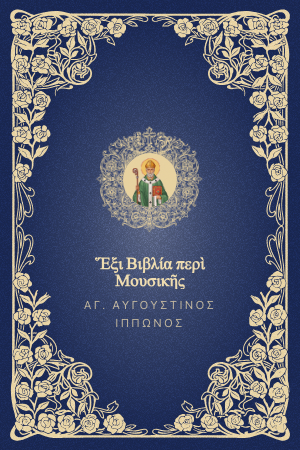
Ἕξι Βιβλία περὶ Μουσικῆς
Αυγουστίνος Ιππώνος · 5ος αιώνας
Η σύντομη απάντηση
Στα «Έξι Βιβλία περί Μουσικής», ο Αυγουστίνος Ιππώνος εξερευνά πολύτιμες γνώσεις για την αρμονία και την πνευματικότητα της μουσικής. Το έργο συνυφαίνει βαθιές φιλοσοφικές σκέψεις με την ιδέα ότι η μουσική χρησιμεύει ως ένα παγκόσμιο μέτρο για τις ανθρώπινες πράξεις.
Διάβασε ένα βιβλίο χωρίς λογαριασμό. Συνδέσου δωρεάν για να συνεχίσεις την ανάγνωση.
- Philosophy and Theology
- Fear of God
Σχετικά με το βιβλίο
| Συγγραφέας | Αυγουστίνος Ιππώνος |
|---|---|
| Εποχή | 5ος αιώνας |
| Κεφάλαια | 80 |
| Στη βιβλιοθήκη μας | Πλήρες κείμενο στα αγγλικά και στα γερμανικά |
Στα «Έξι Βιβλία περί Μουσικής», ο Αυγουστίνος Ιππώνος εξερευνά πολύτιμες γνώσεις για την αρμονία και την πνευματικότητα της μουσικής. Το έργο συνυφαίνει βαθιές φιλοσοφικές σκέψεις με την ιδέα ότι η μουσική χρησιμεύει ως ένα παγκόσμιο μέτρο για τις ανθρώπινες πράξεις. Ο Αυγουστίνος απεικονίζει πώς διάφοροι τόνοι και ρυθμοί συνδυάζονται για να σχηματίσουν ένα αρμονικό σύνολο που υμνεί τον Δημιουργό. Μας προτρέπει να ακούσουμε τον αληθινό ήχο της δημιουργίας και να αναγνωρίσουμε ότι η ομορφιά και η τάξη οδηγούν όλα τα πράγματα πίσω στον Θεό εν σιωπή.
Περιεχόμενα
| # | Κεφάλαιο |
|---|---|
| 1 | Preface. St John Chrysostom from the sixth discourse on Isaiah |
| 2 | Chapter 1: That the principles of harmony are universal. |
| 3 | Chapter 2: What is Music. What is modulation |
| 4 | Chapter 3: What is ‘well-modulated’ and why it is included in the definition of music |
| 5 | Chapter 4. Why the definition of music includes the concept of science |
| 6 | Chapter 5. The Sense of Music; is it inherent by nature? |
| 7 | Chapter 6. Theatre singers do not know music |
| 8 | Chapter 7. The long and short of the movement. |
| 9 | Chapter 8. The long and the short |
| 10 | Chapter 9. Movement rational (comprehensible, sensible, rationabiles) and irrational (incomprehensible, irrationabiles) |
| 11 | Chapter 10. Conjoint (complicated) and sesquicentennial motions |
| 12 | Chapter 11. Motion and number do not advance to infinity, but are held in a definite form |
| 13 | Chapter 12. Why, the progression from one to ten and the return thence to one has become a calculus |
| 14 | Chapter 13. On the Beauty of Proportioned Movements in the measure in which the senses judge it |
| 15 | Book 2, which discusses the metrics of syllables and stops |
| 16 | Chapter 1: Grammar and Music. Authority and Experience |
| 17 | Chapter 2: It is human nature to create a distinction between numerical dimensions |
| 18 | Chapter 3: In which numbers the syllables refer to themselves |
| 19 | Chapter 4. What is a stop and its relation to intervals |
| 20 | Chapter 5. Footings of different sizes and their relation to numbers |
| 21 | Chapter 6. Stops of four syllables |
| 22 | Chapter 7. The feet are the image of God's creation in number and measure |
| 23 | Chapter 8: On the Twenty-eight Stoops |
| 24 | Chapter 9. How the feet are joined together |
| 25 | Chapter 10. On Amphibrachia |
| 26 | Chapter 11. On the principles of the combination of the feet |
| 27 | Chapter 12. The role of the sequence of short and long syllables |
| 28 | Chapter 13. On the order in which the feet are combined |
| 29 | Chapter 14. What foot can be combined with what foot |
| 30 | Book 3, in which there is a discussion of rhythm and metre |
| 31 | Chapter 1: On the Distinction of Rhythm and Metre |
| 32 | Chapter 2: On the two kinds of metres, and which of them is called verse. |
| 33 | Chapter 3: On Dual Rhythms |
| 34 | Chapter 4: On the feet that cannot create rhythm |
| 35 | Chapter 5. Why there cannot be more than four syllables in a foot |
| 36 | Chapter 6. The feet instead of and the feet together |
| 37 | Chapter 7: On the Principle of Composition of Metre |
| 38 | Chapter 8: The Role of the Pause in Metre |
| 39 | Chapter 9. The verse consists of two members |
| 40 | Chapter 1: The indifference of the longitude of the extreme syllable of metre |
| 41 | Chapter 2: The Importance of Tact for the Distinction of Metre |
| 42 | Chapter 3: Metres by order of foot. Metres pyrrhichiae |
| 43 | Chapter 4. Iambic metres |
| 44 | Chapter 5: The Trochic Metre |
| 45 | Chapter 6. Metres spondii |
| 46 | Chapter 7. Metres of tribrachium |
| 47 | Chapter 8: The metres of the dactyl |
| 48 | Chapter 9. The metres of anapest and bacchae |
| 49 | Chapter 10. Metres of other feet |
| 50 | Chapter 11. On private discrepancies in metres |
| 51 | Chapter 12. The total number of metres |
| 52 | Chapter 13. How to determine the metre of a verse |
| 53 | Chapter 14. On metres with partial stops. |
| 54 | Chapter 15. On silence necessary and by choice |
| 55 | Chapter 16. On the mixing of feet and the combination of metres |
| 56 | Chapter 17. On the Circulation of Metre |
| 57 | Chapter 1: Definition of verse |
| 58 | Chapter 2: On the Harmony of Verse |
| 59 | Chapter 3: On the Interaction of the Parts of a Verse |
| 60 | Chapter 4: On the Limits of Verse |
| 61 | Chapter 5: On heroic verse |
| 62 | Chapter 6. On the equal members of a verse |
| 63 | Chapter 7: On Harmony (Verses) of the Second Order |
| 64 | Chapter 8: On heroic verse and derivative harmony |
| 65 | Chapter 9. On the octal feet. |
| 66 | Chapter 10. On the deep harmony of the hexameter verses |
| 67 | Chapter 11. On the dignity of verses with anapestheses |
| 68 | Chapter 12. On the quadratic harmony of heroic verse |
| 69 | Chapter 13. Conclusion. On the cyclical nature of verses |
| 70 | Chapter 1: On the Height of Divine Harmony |
| 71 | Chapter 2: On the first and second sphere of harmony |
| 72 | Chapter 3: The Third and Fourth Spheres of Harmony |
| 73 | Chapter 4. The fifth sphere of harmony |
| 74 | Chapter 5: Of Sense and Health |
| 75 | Chapter 6. The order of the kinds of numbers and their names |
| 76 | Chapter 7. Are the judging numbers immortal? |
| 77 | Chapter 8: Other Numbers are examined from the standpoint of the judging numbers |
| 78 | Chapter 9. Of numbers superior to judging numbers |
| 79 | Chapter 10. On how the mind judges music |
| 80 | Chapter 11. The difference between inferior and superior numbers |
Από την πρώτη σελίδα
Οι πρώτες προτάσεις του κειμένου, όπως εμφανίζονται στον αναγνώστη.
‘If thou wilt see a spectacle, then, leaving the satanic one, come to this spiritual one; if thou wilt listen to the lyre, then, leaving the singing there and straining the power of thy mind, come to listen to this one, which awakens thy thoughts, strengthens thy mind. See how the various sounds and individual strings on all sides raise a single and perfectly consonant chant to the excellent Artist, God.
Ἕξι Βιβλία περὶ Μουσικῆς · πρώτη σελίδα
Περισσότερα έργα: Αυγουστίνος Ιππώνος
 Επιστολές (28, 29, 246, 210)Αυγουστίνος Ιππώνος
 Επιστολή 215Α. Προς Βαλεντίνο του Αδρουμήτου 3ηΑυγουστίνος Ιππώνος
 Επιστολή 258. Προς ΜαρκιανόνΑυγουστίνος Ιππώνος
 Ερμηνεία του Ψαλμού 125Αυγουστίνος Ιππώνος
 Η Πολιτεία του ΘεούΑυγουστίνος Ιππώνος
 Λόγος εκφωνηθείς στην Καρχηδόνα κατά την Εορτή του Αγίου ΚυπριανούΑυγουστίνος Ιππώνος