
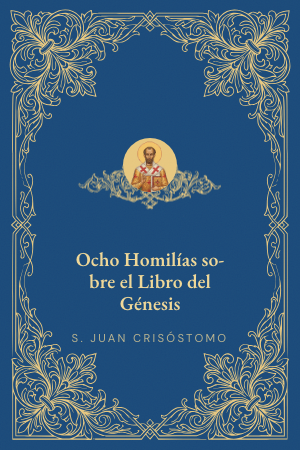
Ocho Homilías sobre el Libro del Génesis
Juan Crisóstomo · siglo 4
La respuesta breve
En sus “Ocho Homilías sobre el Libro del Génesis”, Juan Crisóstomo explora profundas lecciones del primer libro de Moisés.
Lee un libro sin cuenta. Inicia sesión gratis para seguir leyendo.
- Biblical Exegesis and Commentary
- Ayuno
- La caída y el pecado ancestral
- Creación del ser humano
- El mundo visible
Sobre el libro
| Autor | Juan Crisóstomo |
|---|---|
| Época | siglo 4 |
| Capítulos | 10 |
| En nuestra biblioteca | Texto completo en inglés y alemán, audiolibro 2:24:04 |
| Episodio de pódcast | 5 min |
En sus "Ocho Homilías sobre el Libro del Génesis", Juan Crisóstomo explora profundas lecciones del primer libro de Moisés. Profundiza en la creación y el lugar de la humanidad en el orden divino, abordando el ayuno y la limosna como remedios para el alma, instando a los creyentes a participar activamente en su crecimiento espiritual. A través de un elocuente discurso, invita a los oyentes a reconocer la belleza de la creación y a profundizar su relación con Dios. Una guía atemporal para la reflexión espiritual y el crecimiento personal.
Contenido
Capítulos con su tiempo en el audiolibro.
| # | Capítulo | Tiempo en el audiolibro |
|---|---|---|
| 1 | Eight Homilies on the Book of Genesis | 0:00 |
| 2 | Preface | 0:06 |
| 3 | Homily 1. Spoken at the beginning of Great Lent on the words: "In the beginning God created the heaven and the earth" (Gen 1:1), also about fasting and almsgiving. | 2:24 |
| 4 | Homily 2. Why did (God) say about the sun, moon, heaven, and other creatures: "Let there be," and about man: "Let us make"; and what does "in the image" mean? | 23:12 |
| 5 | Discourse 3. What does "according to the likeness" mean, and why do we not have dominion over the beasts, when God said that we should have dominion over them, and that this is a matter of great care | 35:33 |
| 6 | Discourse 4. On the fact that sin introduced three kinds of slavery; also against those who listen carelessly and do not honor their parents. | 46:34 |
| 7 | Homily 5. On the fact that we are not punished for Adam, and that we have received more blessings than evils brought in by him, if we are attentive to ourselves, and against those inattentive to the p | 1:07:36 |
| 8 | Homily 6. On the tree, whether Adam received the knowledge of good and evil from it, or whether he had this knowledge even before tasting; also, on fasting, and on the fact that at home one should r | 1:28:17 |
| 9 | Homily 7. Why the tree is called the tree of the knowledge of good and evil, and what the words mean: "Today you will be with Me in Paradise" (Gen 2:9; Lk 23:43). | 1:39:11 |
| 10 | Homily 8. On the Cloudy Day and the Assembly of Bishops; on the Commandment Given to Adam, and on the Fact that Receiving the Law Was a Sign of Great Care. | 2:11:23 |
Desde la primera página
Las primeras frases del texto, tal como aparecen en el lector.
The eight words on the Book of Genesis are pronounced, as is commonly supposed (see Philaret, Archbishop of Chernigov, “Historical Teaching on the Fathers of the Church.” 1882, vol. ii, pp. 195; “Migne. Patrologiæ cursus completus, ser. gr. t. LIV, p. 579), in the first year of Chrysostom's preaching activity in Antioch, i.e.
Ocho Homilías sobre el Libro del Génesis · primera página
Escuchar
El libro completo como audiolibro, 2 h 24 min (2:24:04).
Un episodio de pódcast sobre el libro, 5 min: Why Adam was never a clueless toddler.
Audiolibro y pódcast en la appSigue escuchando donde lo dejasteMás obras de Juan Crisóstomo
 Palabra contra la Embriaguez y sobre la ResurrecciónJuan Crisóstomo
 Palabra Exhortativa sobre la AbstinenciaJuan Crisóstomo
 Perla EspiritualJuan Crisóstomo
 Resumen de los Libros del Antiguo TestamentoJuan Crisóstomo
 Sermón sobre el Mar de Galilea y San Pedro ApóstolJuan Crisóstomo
 Sobre el Arrepentimiento y la Lectura del Pecado de David con la Esposa de UríasJuan Crisóstomo
Más sobre La caída y el pecado ancestral
 Prueba de la Predicación ApostólicaIreneo de Lyon
 SermonesGennadios Scholarios
 Sobre el misterio de la PascuaAmbrosio de Milán
 Sobre el ParaísoEfrén el Sirio
 Sobre la Honorable y Vivificante Cruz y la Transgresión de los Primeros HombresJuan Crisóstomo
 Sobre la PascuaMelitón de Sardes