
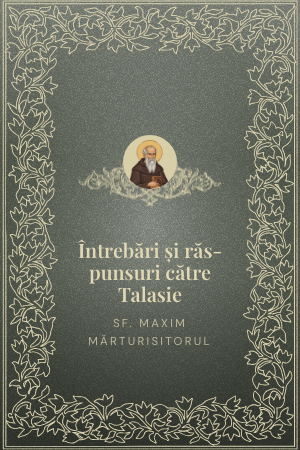
Întrebări și răspunsuri către Talasie
Maxim Mărturisitorul · secolul 7
Răspunsul pe scurt
În “Întrebări și răspunsuri către Talasie”, Maxim Mărturisitorul oferă perspective profunde asupra naturii umane și a patimilor. Printr-o serie de întrebări, el explorează dacă patimile sunt în mod inerent rele sau doar folosite greșit.
Citește o carte fără cont. Conectează-te gratuit pentru a citi mai departe.
- Dogmatics and Polemics
- Lupta duhovnicească
Despre carte
| Autor | Maxim Mărturisitorul |
|---|---|
| Epoca | secolul 7 |
| Capitole | 66 |
| În biblioteca noastră | Text integral în engleză și germană |
| Episod de podcast | 6 min |
În „Întrebări și răspunsuri către Talasie”, Maxim Mărturisitorul oferă perspective profunde asupra naturii umane și a patimilor. Printr-o serie de întrebări, el explorează dacă patimile sunt în mod inerent rele sau doar folosite greșit. Pătrunzând în concepte teologice complexe, el abordează Creatorul activ și relația dintre omenire și Dumnezeu. Această lucrare încurajează reflecția asupra provocărilor morale ale vieții, invitând cititorii să exploreze realitatea divină într-un mod mai profund.
Cuprins
| # | Capitol |
|---|---|
| 1 | Questionnaires to Falassius |
| 2 | Maximus Monachus prologue to the scholia placed in the margin |
| 3 | Maximus the monk to Falassius, the most pious presbyter and abbot, concerning various difficult passages of Holy Scripture. |
| 4 | Question 1 |
| 5 | Question 2 |
| 6 | Question 3 |
| 7 | Question 4 |
| 8 | Question 5 |
| 9 | Question 6 |
| 10 | Question 7 |
| 11 | Question 8 |
| 12 | Question 9 |
| 13 | Question 10 |
| 14 | Question 11 |
| 15 | Question 12 |
| 16 | Question 13 |
| 17 | Question 14 |
| 18 | Question 15 |
| 19 | Question 16 |
| 20 | Question 17 |
| 21 | Question 18 |
| 22 | Question 19 |
| 23 | Question 20 |
| 24 | Question 21 |
| 25 | Question 22 |
| 26 | Question 23 |
| 27 | Question 24 |
| 28 | Question 25 |
| 29 | Question 26 |
| 30 | Question 27 |
| 31 | Question 28 |
| 32 | Question 29 |
| 33 | Question 30 |
| 34 | Question 31 |
| 35 | Question 32 |
| 36 | Question 33 |
| 37 | Question 34 |
| 38 | Question 35 |
| 39 | Question 36 |
| 40 | Question 37 |
| 41 | Question 38 |
| 42 | Question 39 |
| 43 | Question 40 |
| 44 | Question 41 |
| 45 | Question 42 |
| 46 | Question 43 |
| 47 | Question 44 |
| 48 | Question 45 |
| 49 | Question 46 |
| 50 | Question 47 |
| 51 | Question 48 |
| 52 | Question 49 |
| 53 | Question 50 |
| 54 | Question 51 |
| 55 | Question 52 |
| 56 | Question 53 |
| 57 | Question 54 |
| 58 | Question 55 |
| 59 | Question 56 |
| 60 | Question 57 |
| 61 | Question 58 [It is said]: “On this rejoice, having now mourned a little, if need be, from various temptations” (1 Pet 1:6). How can he who mourns in temptations rejoice concerning that which he mourns? |
| 62 | Question 59 To this salvation <...> the studies of the prophets, who foretold of the grace appointed unto you, examining to which and at what time the Spirit of Christ who was in them pointed, when He foretold Christ's sufferings and the glory that followed them” (1 Pet 1:10-11). If the blessed prophets themselves, taught by the Holy Spirit, left to us in writing what they had been taught to study and search out, how could they, taught by the Holy Spirit and writing down what was revealed to them, study and search out anything? |
| 63 | Question 60 |
| 64 | Question 61 |
| 65 | Question 62 |
| 66 | Question 64: What is the meaning of the statement of the prophet Jonah, who says of Nineveh, “In it dwell the greatest number of men, not less than two dozen, and they know not their right hand, nor their shuja (Jonah 4:11)? For in the literal interpretation [of this place] I find no comfort. For the prophet does not here speak of children, nor does he mean infants, but he speaks of men. And what man, if his intellect is not corrupted, does not know his right hand and his shuja? Therefore tell me, what men, what right hand and what shuitsa are here spoken of, according to the sense of spiritual interpretation. |
De la prima pagină
Primele fraze ale textului, așa cum apar în cititor.
Prologue of Maximus the Monk to the Scholia placed in the margin Maximus the monk to Falassius, pious presbyter and hegumen, on various difficult passages of the Holy Scriptures. Questions 1. Are the passions evil in themselves, or are they evil because of their abuse? I mean pleasure and sorrow, desire [and] fear, and [all] the [passions] following them. 2.
Întrebări și răspunsuri către Talasie · prima pagină
Ascultă
Un episod de podcast despre carte, 6 min: Evil is a tool held backward.
Carte audio și podcast în aplicațieContinuă să asculți de unde ai rămasAlte lucrări de Maxim Mărturisitorul
 Lucrări teologice și polemiceMaximus Mărturisitorul
 Un Cuvânt despre SufletMaxim Mărturisitorul
 Zece Capitole despre Virtute și ViciuMaxim Mărturisitorul
 Ambigua către IoanMaxim Mărturisitorul
 Ambigua către Toma despre diverse întrebări la Sfinții Dionisie și GrigorieMaxim Mărturisitorul
 Capitole despre Teologie și Economia Divină a Întrupării Fiului lui DumnezeuMaxim Mărturisitorul