

Habakkuk 3:7 Meaning: What the Church Fathers Say
Because of troubles I looked upon the tents of the Ethiopians: the tabernacles also of the land of Madiam shall be dismayed.
Habakkuk 3:7 · Brenton Septuagint
I saw the tents of Cushan in affliction: and the curtains of the land of Midian did tremble. KJV
The short answer
On another note, the Ethiopians may also symbolize idolaters, whose lives are full of earthly desires and impurity. Indeed, the Ethiopians are devoid of divine enlightenment, and metaphorically, their hearts are dark and their thoughts obscured.
Cyrill of Alexandria, 5th century
What the Church Fathers say about Habakkuk 3:7
5 commentators · all with a free account
Ambrose of Milan339 to 397  Jerome of Stridon4th century
Augustine of Hippo354 to 430  Cyrill of Alexandria5th century
“The territories of Ethiopia will tremble, as will the refuge of Midian. Narratives that hold significance always include elements worthy of attention, offering insights that satisfy even when expressed repetitively.”
The whole commentary
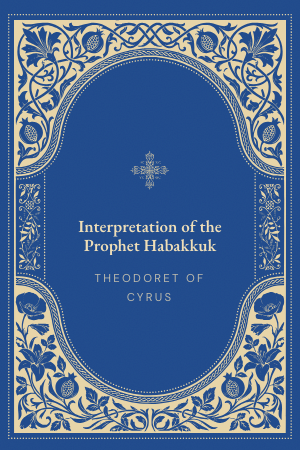
The territories of Ethiopia will tremble, as will the refuge of Midian. Narratives that hold significance always include elements worthy of attention, offering insights that satisfy even when expressed repetitively. Thus, after detailing the defeat of opposing forces and illustrating their dissolution as if they were overturned mountains, he draws a parallel with the outsiders who contended against the land of Israel. These outsiders included the Ethiopians, who resided to the east and south near the Indian Sea, and the Midianites, who lived in the adjacent desert. Consequently, it is stated that “they shall fear” those who opposed the sacred city, which we understand to represent spiritual Zion or the Church of Christ, inhabited by the saints and the chosen people, reminiscent of ancient Israel, for Israel denotes ‘the one who perceives God.’ Nathanael exemplifies this as “an Israelite indeed, in whom is no guile” (John 1:47). Thus, through the imagery of the Ethiopians and Midianites, who repeatedly sought to harm God's chosen, we can infer a representation of the demonic forces that are adversarial to the saints. On another note, the Ethiopians may also symbolize idolaters, whose lives are full of earthly desires and impurity. Indeed, the Ethiopians are devoid of divine enlightenment, and metaphorically, their hearts are dark and their thoughts obscured. It is noted that the serpent has been allotted to them, as David proclaims to the Almighty: “You have broken the head of the serpent; you have given it to the people of Ethiopia” (Psalm 73:14). Just as the life-giving word of God has become our spiritual sustenance, those who revel in sin and lack knowledge of the true God consume the essence of Satan, embodying him in their thoughts and speech, which gratify him. The Midianites have historically opposed the saints. Delving deeper into the meaning of the term “Midianite,” it can be understood as “condemned.” This label aptly describes Satan himself and the evil entities aligned with him, “for whom the gloom of utter darkness is kept forever” (Jude 1:13).
 Theodoret of Cyrus5th century
1 / 5
Or in the Bible reader with a free account: read all 5 commentaries.
In our library
Habakkuk 3:7 in context
3:5Before his face shall go a report, and it shall go forth into the plains,
3:6the earth stood at his feet and trembled: he beheld, and the nations melted away: the mountains were violently burst through, the everlasting hills melted at his everlasting going forth.
3:7Because of troubles I looked upon the tents of the Ethiopians: the tabernacles also of the land of Madiam shall be dismayed.
3:8Wast thou angry, O Lord, with the rivers? or was thy wrath against the rivers, or thine anger against the sea? for thou wilt mount on thine horses, and thy chariots are salvation.
3:9Surely thou didst bend thy bow at sceptres, saith the Lord. Pause. The land of rivers shall be torn asunder.
Cross references for Habakkuk 3:7
- Ex 15:14The nations heard and were angry, pangs have seized on the dwellers among the Phylistines.
- Ex 15:16Let trembling and fear fall upon them; by the greatness of thine arm, let them become as stone; till thy people pass over, O Lord, till this thy people pass over, whom thou hast purchased.
- Num 31:2Avenge the wrongs of the children of Israel on the Madianites, and afterwards thou shalt be added to thy people.
- Num 31:12And they brought to Moses and to Eleazar the priest, and to all the children of Israel, the captives, and the spoils, and the plunder, to the camp to Araboth Moab, which is at Jordan by Jericho.
- Judg 7:24And Gedeon sent messengers into all mount Ephraim, saying, Come down to meet Madiam, and take to yourselves the water as far as Bæthera and Jordan: and every man of Ephraim cried out, and they took the water before hand unto Bæthera and Jordan.
- Judg 7:25And they took the princes of Madiam, even Oreb and Zeb; and they slew Oreb in Sur Oreb, and they slew Zeb in Jakephzeph; and they pursued Madiam, and brought the heads of Oreb and Zeb to Gedeon from beyond Jordan.
- Gen 10:6And the sons of Cham, Chus, and Mesrain, Phud, and Chanaan.
- Gen 10:7And the sons of Chus, Saba, and Evila, and Sabatha, and Rhegma, and Sabathaca. And the sons of Rhegma, Saba, and Dadan.
Keep reading in Habakkuk 3
Read Habakkuk 3 in full · Open in the Bible reader